Nuvexa Bug ControlNuvexa Bug Control

Subterranean Termite Soil and Structural Treatment Boston

Boston properties present distinct subterranean termite vulnerabilities due to dense lot lines, damp coastal soil, and historic timber architecture. In historic neighborhoods like Beacon Hill, Back Bay, and the South…
Get My Free Estimate →(857) 737-8390
Subterranean Termite Soil and Structural Treatment in Boston, MA
Quick answer
  • What is included: Continuous exterior trenching, foundation soil saturation with non-repellent liquid termiticide, localized interior slab/rubble drilling, and direct structural timber borate treatments.
  • Response timeframe: On-site clinical evaluation within 24 to 48 hours across Suffolk County; comprehensive structural treatments are completed in a single 4 to 8 hour session.
  • Cost range: Ballpark costs range from $850 to $3,200 for residential structures, with targeted spot treatments starting at the $200 minimum; exact investment is confirmed following physical structural inspection.
  • What we treat: Eastern subterranean termite mud tubes, hollowed sill plates, infested joists, sub-slab colonies, and soil contact zones around stone, brick, and concrete foundations.
  • How to schedule: Contact Nuvexa Bug Control at (857) 737-8390 to schedule a technical inspection; digital photos of active swarms, mud tubes, or timber frass can be submitted for preliminary assessment.

Boston properties present distinct subterranean termite vulnerabilities due to dense lot lines, damp coastal soil, and historic timber architecture. In historic neighborhoods like Beacon Hill, Back Bay, and the South End, eastern subterranean termites travel up fieldstone, granite, and brick foundations through mortar voids to reach structural wood. Subterranean termite soil and structural treatment stops this migration by establishing an uninterrupted chemical perimeter around the foundation perimeter. The non-repellent liquid termiticide binds to the soil particles without dispersing airborne vapors, remaining undetectable to the insects so workers carry the active compound back to the subterranean nesting galleries, eliminating the central colony within 60 to 90 days.

Subterranean termite soil treatment applies to structural foundations with direct ground contact, whereas above-ground localized foaming or borate treatments apply directly to active galleries within interior structural lumber. The structural trade-off centers on non-disruptive trenching versus precision drilling: exterior soil saturation preserves landscape plantings without excavation, while interior concrete slabs, brick sidewalks, or historic basement flagstones require micro-drilling at 12-inch intervals to inject termiticide directly into hidden soil channels beneath. For historic wooden floor systems common in Charlestown, Jamaica Plain, and Dorchester three-deckers, structural treatments incorporate concentrated disodium octaborate tetrahydrate applied straight to damp basement sill plates and floor joists to provide permanent wood-decay and insect-ingestion resistance.

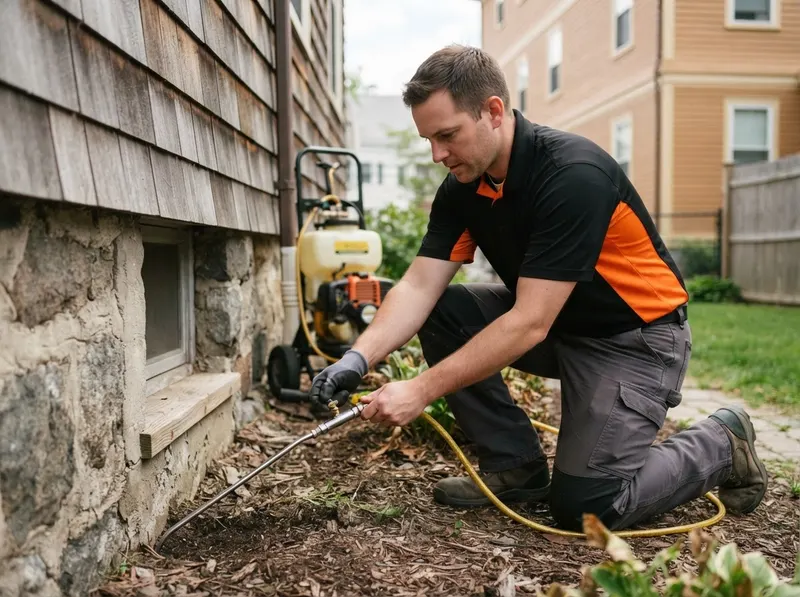
Treatment execution follows four distinct phases. Step 1: Technicians conduct a tactile acoustic and moisture survey of sill plates, carry beams, and cellar perimeter walls using probing tools and non-destructive moisture meters. Step 2: An exterior trench measuring 6 inches wide by 6 inches deep is excavated directly adjacent to the foundation wall. Step 3: Non-repellent termiticide is applied at an exact label rate of 4 gallons per 10 linear feet per foot of depth, saturating the backfill soil to the top of the footing. Step 4: Finished basement floors, stoops, or attached brick patios in East Boston, Brighton, and South Boston are micro-drilled with 0.5-inch masonry bits, pressurized beneath the slab, and sealed flush with color-matched masonry compound. Homeowners and pets may remain safely inside the residence during exterior operations as non-repellent soil termiticides do not aerosolize and bind tightly to organic matter.

Subterranean Termite Soil and Structural Treatment cost in Boston

Targeted Entry-Point or Localized Barrier (Minimum Service)$200, $450
Attached Rowhouse Foundation Trenching (South End / Charlestown)$850, $1,650
Detached Multi-Family Full Perimeter & Slab Injection (Dorchester / Jamaica Plain)$1,400, $2,850
Comprehensive Historic Timber Borate & Deep Perimeter Soil Defense$2,200, $3,200

Every job gets a firm, written price after a free on-site visit.

Common questions

How much does subterranean termite soil and structural treatment cost in Boston?
Subterranean termite soil and structural treatment in Boston costs between $850 and $3,200 for full foundation defense, with small localized treatments starting at the company minimum of $200. Pricing is governed by foundation linear footage, soil composition, basement finishings, and whether concrete slab micro-drilling is required; the exact investment is confirmed after physical measurements are verified on-site.
Will termite treatments in Boston foundations endanger household pets or garden vegetation?
Modern soil termiticides do not endanger household pets or outdoor landscaping when applied by certified professionals. The non-repellent compound is trenched and injected directly beneath the topsoil layer, where it adheres immediately to soil minerals and wood fibers without surface residue, odor, or airborne off-gassing.
How does Boston's historic architecture affect subterranean termite structural treatments?
Boston's historic fieldstone, rubble, and brick foundations contain interior voids that subterranean termites use to access structural timber without building exposed mud tubes. Treatment for buildings in neighborhoods like Beacon Hill and the South End requires low-pressure liquid void flooding and interior micro-drilling to ensure the barrier reaches beneath the stone footing, accompanied by timber borate saturation.
How long does a professional subterranean termite soil treatment remain effective in Boston?
A professional non-repellent liquid soil treatment remains active in Boston soil for 5 to 10 years, depending on local rainfall, soil acidity, and ground drainage. Structural borate treatments absorbed into dry historic structural lumber do not degrade over time and deliver permanent timber protection provided the wood is shielded from direct, running water.
Does a subterranean termite soil treatment require drilling inside my Boston home?
Interior drilling is only required when finished concrete basement slabs, attached masonry stoops, or brick patios directly abut the foundation wall where termites enter. If a Boston residence features an open-dirt crawlspace or unpaved basement perimeter, technicians saturate the soil directly through trenching and rodding without drilling indoor surfaces.
Helpful resources

Trusted references & local links

USA.gov, government & consumer helpBetter Business BureauFTC Consumer AdviceU.S. Small Business AdministrationReady.govU.S. EPAENERGY STARU.S. Dept. of EnergyConsumer.govU.S. Census BureauGoogle Maps, Boston, MA

Get started today

Tell us about your subterranean termite soil and structural treatment job in Boston and we'll send a clear, written quote, usually the same day.
Get your free PEST CONTROL SEVICE quote, Boston

We only use your ZIP to check availability, no spam.